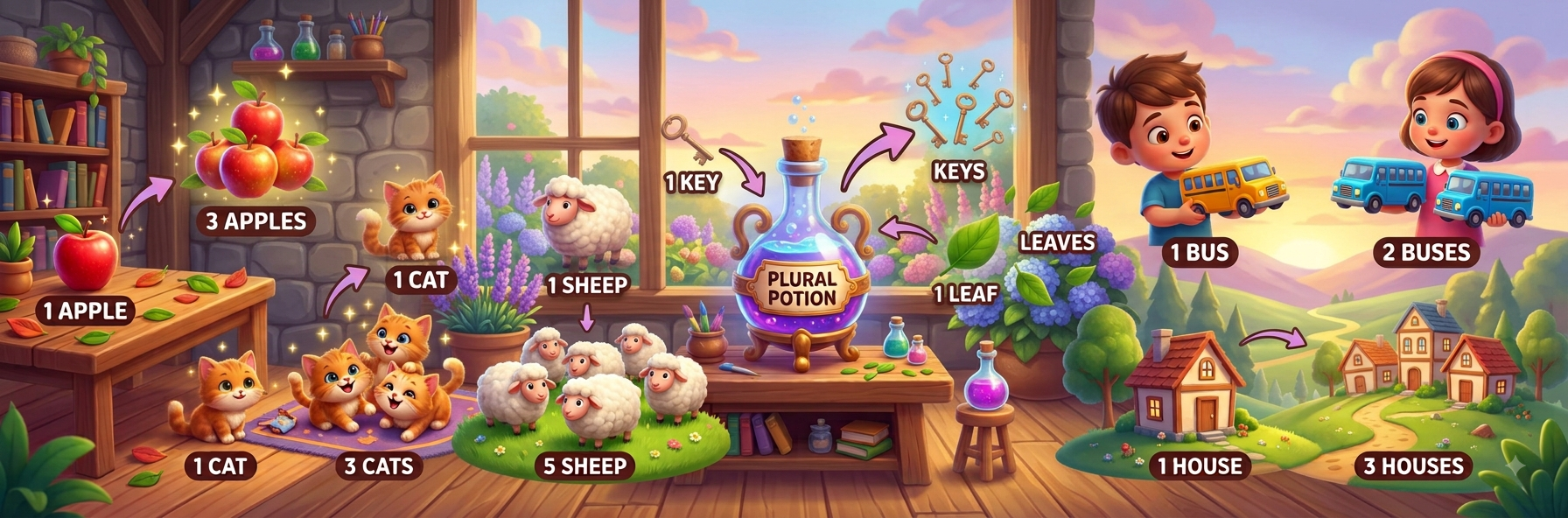
📘 Comment former le pluriel ?
| 📌 Règle | 💬 Exemple |
|---|---|
| Cas général : on ajoute -s | a book → two books |
| Mots en -s, -ss, -sh, -ch, -x, -z : on ajoute -es | a bus → buses · a box → boxes |
| Mots en consonne + y : y → ies | a baby → babies (mais : a day → days, car voyelle + y) |
| Mots en -o : souvent -es | a tomato → tomatoes (exception : a photo → photos) |
| Mots en -f / -fe : souvent -ves | a leaf → leaves · a knife → knives |
| ⚠️ Pluriels irréguliers : forme totalement différente, à apprendre par cœur | a man → men · a woman → women · a child → children · a foot → feet · a tooth → teeth · a mouse → mice · a person → people |
✏️ Put the words between brackets into the plural form
1. You use two (book) of English.
2. There are twenty (student) in the class.
3. There are eight (boy) and twelve (girl).
4. One euro is equal to hundred (cent).
5. A Boeing 747 has got four (engine).
6. (woman) have a lot of (dress) and (bra).
7. I buy a pack of (tomato) and six (bottle) of water.
8. Brussels has got a lot of (park).
9. There are many (map) in an atlas.
10. They have more than three (ship).
11. Controllers follow a lot of (flight) at the same time.